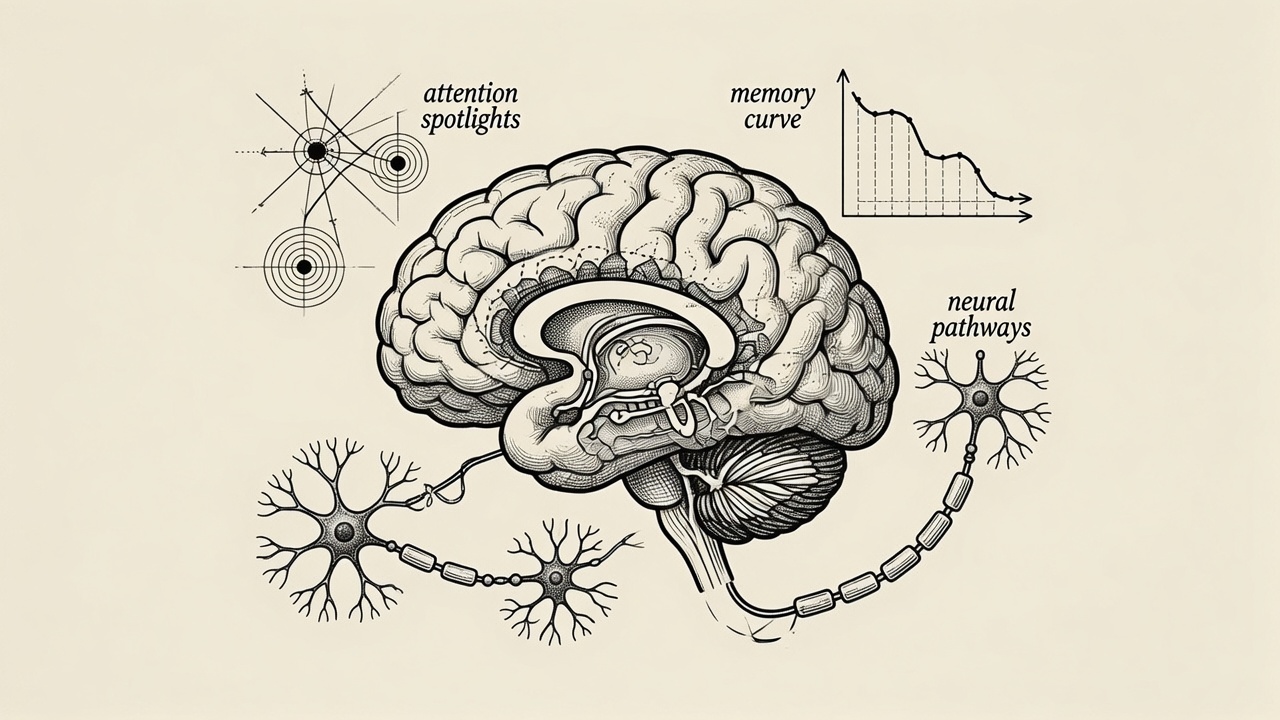
Mind & Behavior
Cognitive psychology, neuroscience, and behavioral science applied to design — grounded in the actual mechanisms, not just the named effects.
Hick's Law
Hick's Law states that the time it takes for a person to make a decision increases logarithmically with the number of choices available.
The Zeigarnik Effect
The Zeigarnik Effect describes our tendency to remember unfinished or interrupted tasks more vividly than completed ones, as the mind maintains cognitive tension until closure is achieved.
How attention actually works
Selective attention is the brain’s mechanism for focusing on relevant stimuli while filtering out the irrelevant, operating as a limited-capacity filter that prevents sensory overload.
Working memory and the real meaning of cognitive load
Working memory is the brain’s limited-capacity system for holding and manipulating information in the moment, while cognitive load refers to the total mental effort demanded of it during a task.
The peak-end rule
The peak-end rule states that people judge an experience primarily by its most intense moment (the peak) and how it ends, rather than the total sum or average of the entire duration.
The neuroscience of habit formation
The neuroscience of habit formation explains how repeated behaviors shift from deliberate, goal-directed actions in the prefrontal cortex to automatic routines encoded primarily in the basal ganglia, reinforced by dopamine signaling in response to cues and rewards.
How memory consolidation works
Memory consolidation is the process by which fragile short-term memories are stabilized into durable long-term storage, primarily during sleep and through spaced practice, as the brain replays and reorganizes experiences from the hippocampus to the neocortex.
The biology of stress and interface design
Stressful interfaces activate the body’s hypothalamic-pituitary-adrenal (HPA) axis, triggering cortisol release and sympathetic nervous system arousal that can impair cognition, elevate heart rate, and over repeated exposure contribute to measurable physiological wear.
Change blindness and inattentional blindness
Change blindness is the failure to detect significant visual changes in a scene when they occur during a brief disruption or distraction; inattentional blindness is the failure to notice an unexpected but fully visible stimulus when attention is focused on another task.
Emotion as the brain's operating system
Emotion acts as the brain’s operating system: it continuously evaluates situations for relevance to wellbeing, modulates attention, memory, decision-making, and motivation, and prepares the body for action — making it foundational to every interaction rather than a decorative afterthought.
The framing effect
The framing effect is the tendency for people to make different decisions based on how the same information is presented — as a gain or a loss, positive or negative — even when the underlying facts remain identical.